Why Hand Tufted Rugs Are Becoming a Design Choice, Not Just a Budget Alternative

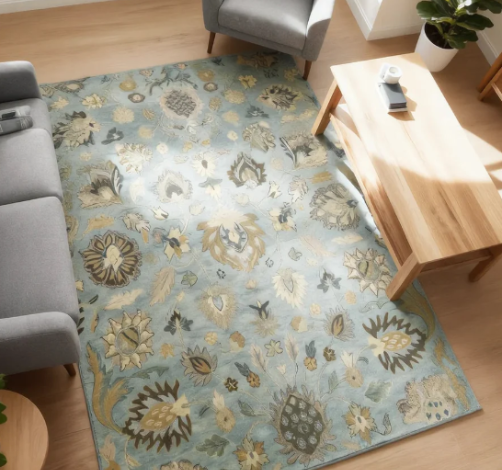
There is a particular kind of rug that makes sense when the room has already been designed around a very specific idea. Perhaps the sofa is an unusual shape, the coffee table is sculptural, or the flooring needs a stronger visual element without introducing another piece of furniture.
This is where hand tufted rugs deserve a more considered place in interior design. Their appeal is not simply that they generally cost less than comparable hand knotted rugs. The construction allows designers to work with varied pile heights, carved surfaces, contrasting textures and graphic patterns in ways that suit contemporary interiors.
For Indian homes, where a single room can combine inherited furniture, contemporary upholstery, decorative objects and changing family requirements, that design flexibility has practical value.
The Real Difference Is What Can Be Done to the Surface
Hand tufting begins with a primary backing stretched across a frame. An artisan uses a handheld tufting gun to insert yarn through the backing, creating loops or cut pile. The reverse is then secured with an adhesive layer and usually covered with a secondary backing. This differs fundamentally from hand knotting, where individual knots are tied around foundation threads.
That difference affects the finished rug. Hand tufting can accommodate sculpted outlines, raised motifs, mixed pile heights and more freely interpreted designs. A floral motif, for example, can be given a raised surface while the surrounding background remains lower. The technique is particularly useful when the design needs to be experienced through touch as well as colour.
Why Contemporary Indian Interiors Have Room for This Construction
Look at the variety of furniture now found within Indian living spaces. A traditional teakwood sideboard might sit opposite a contemporary sectional sofa. A curved accent chair may share the room with a carved wooden coffee table. In some homes, artwork and architectural lighting already provide substantial visual detail.
A conventional all-over pattern traditional rug is not always the most interesting response to such interiors.
A sculpted hand tufted abstract rug can introduce texture without adding another elaborate motif. A geometric design can establish order beneath furniture with rounded silhouettes. An abstract composition can introduce colour into a room where the upholstery and walls are deliberately restrained.
In a compact apartment, this flexibility can be useful when the rug needs to create a focal point without demanding additional furniture or wall decoration. In a larger residence, it can help distinguish a reading corner, formal seating arrangement or secondary lounge.
The important consideration is not whether the home is expensive. It is whether the rug has a clear design role.
The Difference Between a Beautiful Surface and a Well-Made Rug
Hand tufting offers considerable creative freedom, but buyers should not confuse surface detail with construction quality. Two rugs may look equally plush in product photographs while differing substantially in yarn composition, pile density, backing, and finishing.
India’s BIS standard, IS 5884:2020, specifically addresses hand-tufted carpets. Its specifications cover characteristics including pile yarn, pile height, pile density, dimensions, and relevant performance tests. The standard was reviewed in 2025.
For a buyer, this creates a more useful set of questions:
- Pile composition: Is the face yarn wool, viscose, polyester, or a blend? What is the actual percentage?
- Pile height: Is the surface uniformly cut, looped, or sculpted?
- Pile density: How closely are the tufts placed?
- Backing: What adhesive and secondary backing materials are used?
- Finishing: Are the edges secure and the carved sections cleanly defined?
These specifications reveal more than a generic claim of premium craftsmanship.
The Backing Is Not a Detail to Ignore
Unlike a hand knotted rug, a conventional hand-tufted rug relies on an adhesive system to secure its tufts. The quality and condition of that backing therefore matter. This becomes especially relevant in Indian homes where an area rug may sit on polished marble, vitrified tiles or another hard flooring surface. Buyers should ask about the backing material, manufacturing quality and care requirements rather than assuming that every hand tufted rug will behave identically.
A poorly maintained or deteriorating backing can compromise the area rug even when the visible pile initially looks attractive. Moisture exposure and unsuitable cleaning methods deserve particular attention. The underside is part of the product, not an afterthought.
Where Hand Tufting Makes the Strongest Design Case
Its flexibility becomes particularly useful in interiors that need a deliberate surface treatment.
Consider three different design situations:
- A neutral living room: A sculpted wool rug can introduce texture without competing with restrained upholstery.
- A contemporary drawing room: An abstract or geometric composition can connect the rug with the furniture’s shapes and proportions.
- A bedroom with minimal furniture: A softer pile and a considered tonal palette can give the floor a more substantial visual presence.
The same logic applies to colour. A restrained palette may suit a room with elaborate furniture, while a more graphic design can give a relatively plain interior its defining feature. The area rug should respond to what is already present rather than introduce another unrelated design statement.
It Is Not a Substitute for Every Other Rug Construction
Hand tufting has a distinct place, but it is not automatically the better choice. Hand knotted rugs have a different construction, with individual knots forming the pile. Handwoven and flatweave rugs offer another surface character altogether. The appropriate choice depends on the desired design, construction, intended use, and maintenance expectations.
A buyer looking for a particular sculpted motif may find hand tufting especially suitable. Someone seeking a traditionally knotted structure may have an entirely different brief. The more useful question is not which construction wins. It is which one can deliver the design and performance the room requires.
A Design Decision in Its Own Right
The value of a hand tufted rug lies in the relationship between its construction and the design it makes possible. Its appeal should not be reduced to a price comparison with hand knotted alternatives. When the surface, pile, colour and proportions are considered together, hand tufting becomes a deliberate interior-design choice. The workmanship still needs scrutiny, but the construction deserves to be judged on what it can create, not merely on what it costs.