

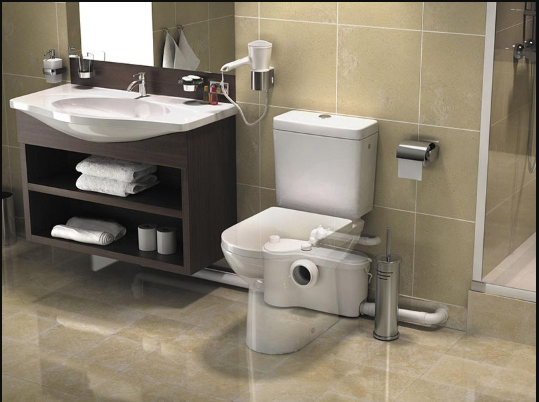
Adding an additional toilet to a home, office, commercial property or renovated space can become surprisingly complicated when the location is far from the existing drainage system. Traditional plumbing relies heavily on gravity, which means wastewater needs an appropriately positioned drainage pipe with sufficient slope. When that isn’t possible, property owners may assume that extensive floor cutting, excavation or major plumbing modifications are unavoidable.
A macerator pump provides another approach.
Macerator systems are designed to process wastewater from a toilet and pump it through a smaller discharge pipe toward an existing drainage connection. This can provide considerably more flexibility when planning a new bathroom or WC in an existing building.
One of the main advantages of this type of system is that it can be considered during renovation projects. For example, a homeowner may want to add a toilet in a basement, convert an unused room into a guest bathroom, or create an additional WC in an office. In these situations, the location of the existing soil pipe can become a major design constraint.
A compact macerator can help overcome that constraint by collecting wastewater from the WC, processing it and pumping it to the appropriate drainage point. SFA’s Saniflo Macerator pump, for example, is designed specifically for applications where conventional gravity drainage is difficult. The product can handle one WC and is designed to pump wastewater up to 5 metres vertically or up to 100 metres horizontally, subject to the installation conditions and manufacturer’s requirements.
Another consideration is installation space. A bathroom renovation often has limited room behind or around the toilet. A compact unit that fits behind the WC can therefore be useful where installing conventional large-diameter drainage would be impractical.
However, choosing a macerator should not be based solely on the maximum pumping distance. The actual vertical lift, horizontal run, pipe routing, number of fixtures and wastewater characteristics all need to be considered. Installation should also follow the manufacturer’s specifications and applicable plumbing requirements.
Maintenance is another part of the equation. Although modern macerator systems are designed for reliable operation, sensible use and periodic cleaning can help maintain performance. Items that are unsuitable for toilet drainage should never be flushed into the system.
For renovation projects, the biggest benefit of a compact macerator is design flexibility. Instead of allowing the location of an existing drainage pipe to determine where a toilet can be installed, homeowners and designers can investigate pumping as an alternative.
For a single additional WC, a dedicated solution such as SFA’s Saniflo can therefore be considered when conventional gravity drainage presents a challenge. The final selection should always be based on the project’s actual plumbing layout and technical requirements.